
Journal›Philosophy & Practice
Philosophy & Practice
Why Stillness Is Not the Goal:
A Reading of Patanjali for Modern Life

Shruthi BhattFounder, Chittamandara Wellness
8 min readPhilosophy & Practice
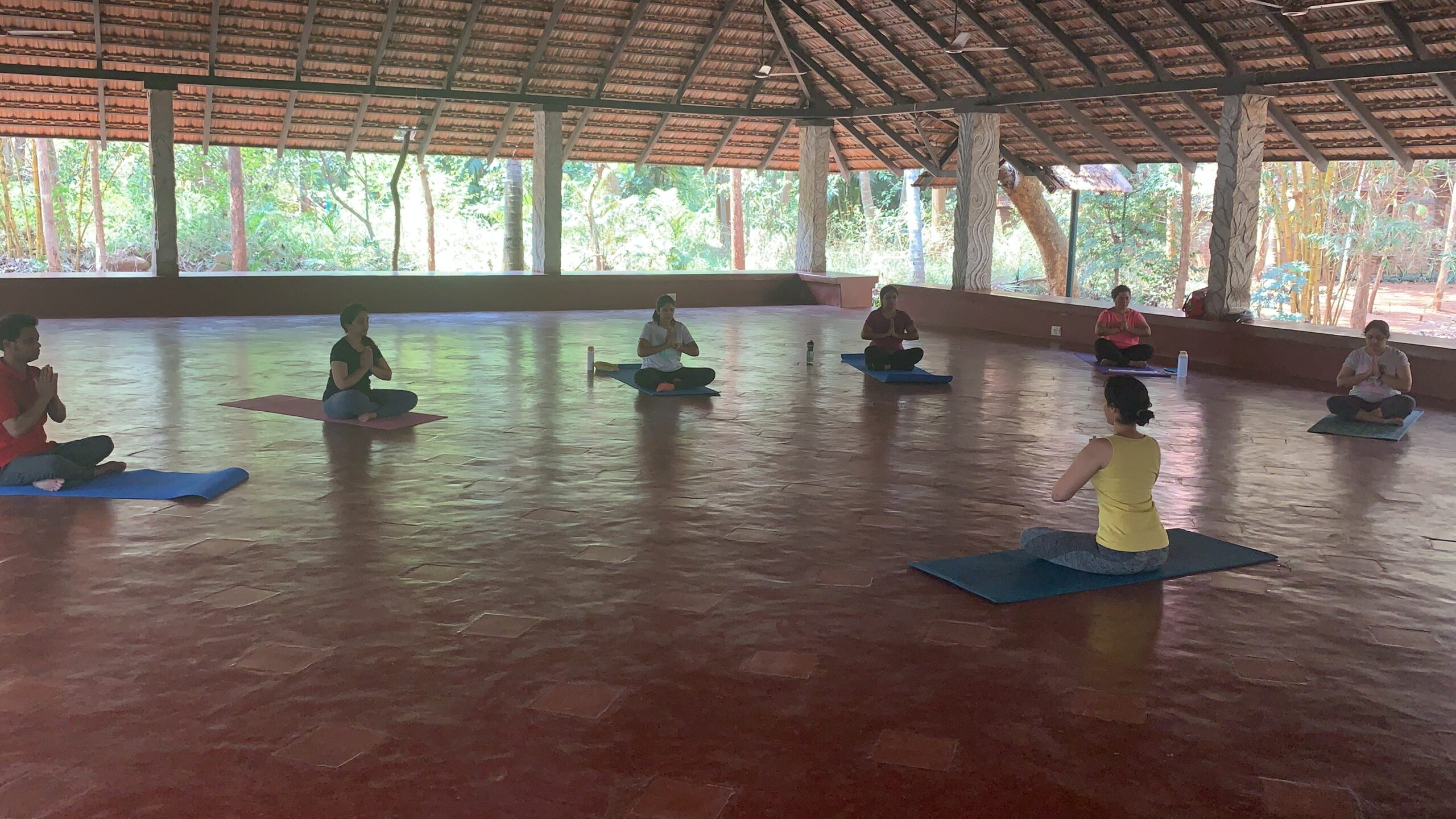
Most people who come to yoga are looking for peace. They have heard the word — in conversations, in wellness articles, in the quiet promises of retreat brochures — and they arrive at the mat carrying an idea of what yoga is supposed to give them. Stillness. Silence. A mind that has finally stopped.
I understand this deeply. I carried the same idea for years. And I want to offer something that may, at first, feel like a contradiction: the Yoga Sutras of Patanjali do not promise you peace.
What they offer is something far more useful, far more honest, and — when you truly sit with it — far more liberating.
✦
What Patanjali Actually Said
The Yoga Sutras open with one of the most quoted lines in all of yogic philosophy: Yogaś citta-vṛtti-nirodhaḥ. It is typically translated as “Yoga is the cessation of the fluctuations of the mind.” And from this translation, an entire generation of practitioners has concluded that the goal of yoga is to stop thinking — to arrive at a mental silence so complete that the turbulence of ordinary life simply dissolves.
But this reading, while poetic, misses something essential.
The word nirodha does not mean elimination. It does not mean suppression. It comes from a root that means to contain, to regulate, to bring into coherence. Patanjali is not describing a mind that has gone silent. He is describing a mind that has learned to hold its own fluctuations — to witness them without being swept away by them.
“The goal is not a mind that has stopped. It is a mind that has learned to remain steady while everything inside it continues to move.”
This is a completely different aspiration. And one that has profound implications for how we practice — and how we live.
✦
The Fluctuating Mind Is Not the Problem
We live in a culture that has pathologised the active mind. Distraction, overthinking, emotional turbulence — these are treated as failures of character or discipline. The wellness industry has responded with an enormous arsenal of techniques, apps, retreats, and protocols designed to quiet the noise.
But the mind’s movement is not the problem. It is, in fact, its nature.
Patanjali names five categories of citta-vritti — five types of mental movement — and notably, not all of them are described as painful. Some fluctuations are clear, accurate, nourishing. The problem is not that the mind moves. The problem is that most of us have lost the capacity to stand apart from the movement — to be present to our thoughts without being identical to them.
When a difficult emotion arises, we do not experience it and let it pass. We become it. When a fear surfaces, it does not visit — it takes up residence. When a worry begins, it loops and compounds until we cannot remember what the original thought even was.
This is what Patanjali is addressing. Not the movement itself. The loss of the one who watches.
The Witness and the Seer
In the second chapter of the Sutras, Patanjali introduces the concept of the drashtr — the Seer. The one who observes. He makes a distinction that is, in my view, the single most important idea in the entire text: the difference between the drashtr (the pure awareness that witnesses) and the drshya (everything that is witnessed — thoughts, sensations, emotions, perceptions).
The suffering of ordinary human life, says Patanjali, arises from the confusion between these two. We forget that we are the one who sees. We mistake ourselves for what is being seen.
Yoga — in its truest sense — is the practice of remembering the difference. Not once, in a moment of spiritual insight. But again and again, in the ordinary moments of an ordinary day. On the mat and off it. In meditation and in conversation. In ease and in difficulty.
“Yoga is not about achieving a state. It is about remembering who you are beneath every state you pass through.”
✦
What This Means for Your Practice
If stillness is not the goal, then what are we doing when we come to the mat? What are we cultivating in meditation, in pranayama, in the long held asanas that ask our bodies to be quiet?
We are training the capacity to be present — without grasping, without resistance, without the habitual urgency to make experience different from what it is.
We are building, slowly and patiently, what I think of as inner steadiness. Not the stillness of a frozen lake — cold, fixed, lifeless. But the steadiness of deep water. Beneath the surface waves, something remains unbroken. Something holds.
This is why a consistent yoga practice changes how you move through the world. Not because you have become calmer — though you may find that you have. But because you have begun to recognise the difference between the weather and the sky. Between what passes through you and what you actually are.
A Practice for Today
The next time you sit to meditate — or the next time life hands you something difficult — try this shift in intention. Instead of asking: can I make this quieter? Ask instead: can I be with this, exactly as it is, without needing it to be different?
Notice what arises. Notice the one who notices. And notice — gently, without judgment — that the one who notices is never in distress. It is always, already, at rest.
That is what Patanjali was pointing to. Not the cessation of life’s movement. But the discovery of the stillness that was always already there — beneath the movement, holding it all.
✦
This article is drawn from Shruthi’s teachings on the Yoga Sutras of Patanjali, offered as part of Chittamandara’s Philosophy & Practice workshops. If these ideas resonate with you, we would love to welcome you into a class or conversation.

About the AuthorShruthi Bhatt
Shruthi is a yoga teacher, mindfulness guide, and therapeutic wellness practitioner based in Bangalore. She holds a RYT 500 in Hatha Yoga, an MA in Counselling Psychology, and has worked with 5,000+ students across India and internationally. She founded Chittamandara Wellness to offer a space where ancient philosophical frameworks meet the honest complexity of modern life.
Begin your own practice of inquiry.
If this article spoke to something in you, we would love to welcome you into a class, workshop, or conversation with Shruthi — in person in Bangalore, or online from anywhere in the world. Connect with Shruthi on WhatsApp